Define a Open Infeference v2 Function
This section describes how to define a openinference-runtime handler. A handler is a Python function declared with the standard def keyword. The runtime injects reserved arguments and provides helpers to map inputs and outputs. See the Open Inference Protocol for more details.
Function Anatomy
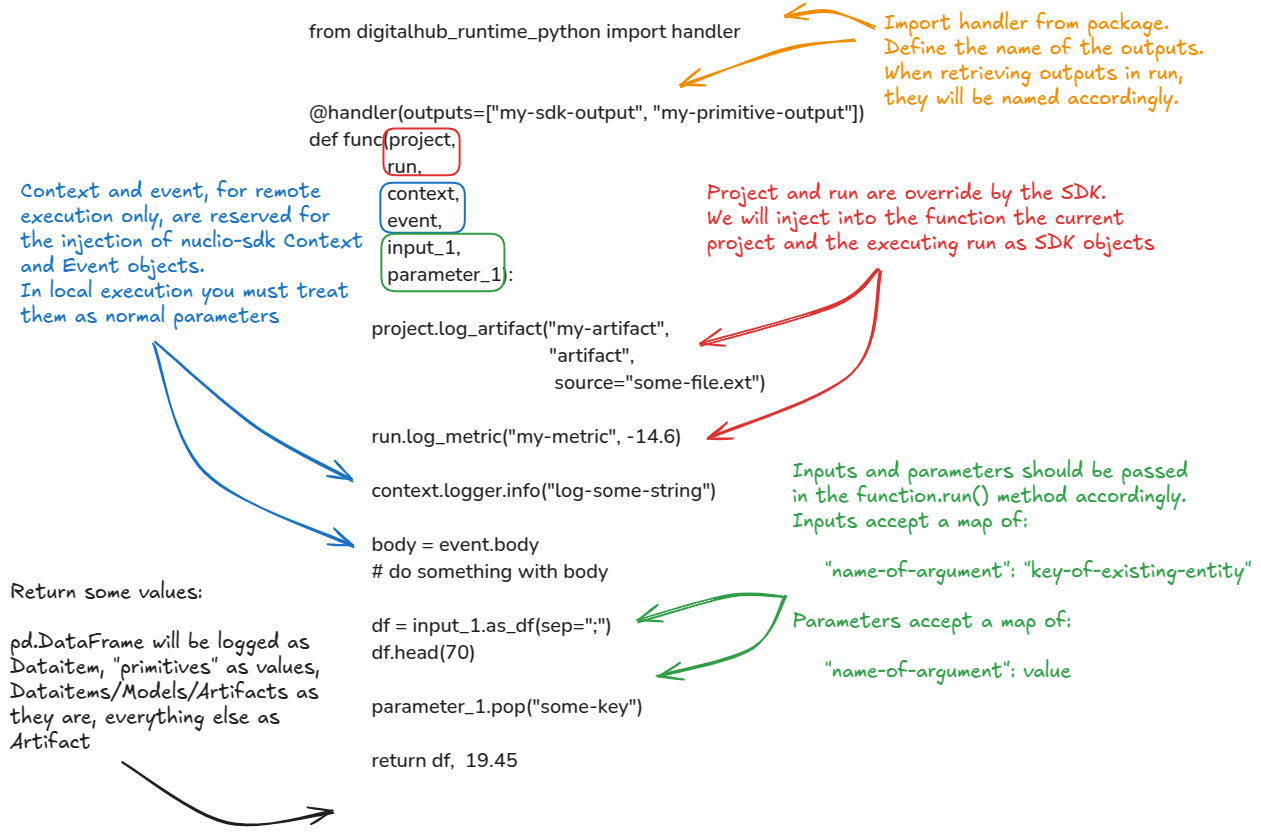
Example handler:
from digitalhub_runtime_python import handler

def func(project, run, context, event, request):
    run.log_metric("my-metric", -14.6)
    image_bytes = request.inputs[0].data

    return {
        "outputs":
            [
                {"name": "caption", "datatype": "BYTES", "data": [caption], "shape": [1, len(caption)]}
            ]

    }
The function you define becomes the entrypoint when referenced as the handler in the run configuration.
Reserved arguments
The runtime injects a small set of reserved arguments when it invokes your handler. Commonly injected values are:
project— the currentProjectobject.run— the activeRunobject.context— the Nuclio runtime context object (see Nuclio Python runtime docs) — only available in remote execution.event— the Nuclio event object — only available in remote execution.request- A body of the OpenInference InferRequest object with the corresponding fields.
Init function
When executing remotely, the Nuclio wrapper calls an init function (if present) before invoking your handler. The runtime injects the Nuclio context into init at invocation time. Additional parameters may be supplied via init_parameters in function.run().