Define a Guardrail Function
This section describes how to define a Guardrail-runtime handler. A handler is a Python function declared with the standard def keyword. Handlers can be simple or accept platform-provided objects and inputs. The runtime injects reserved arguments and provides helpers to map inputs and outputs.
Function Anatomy
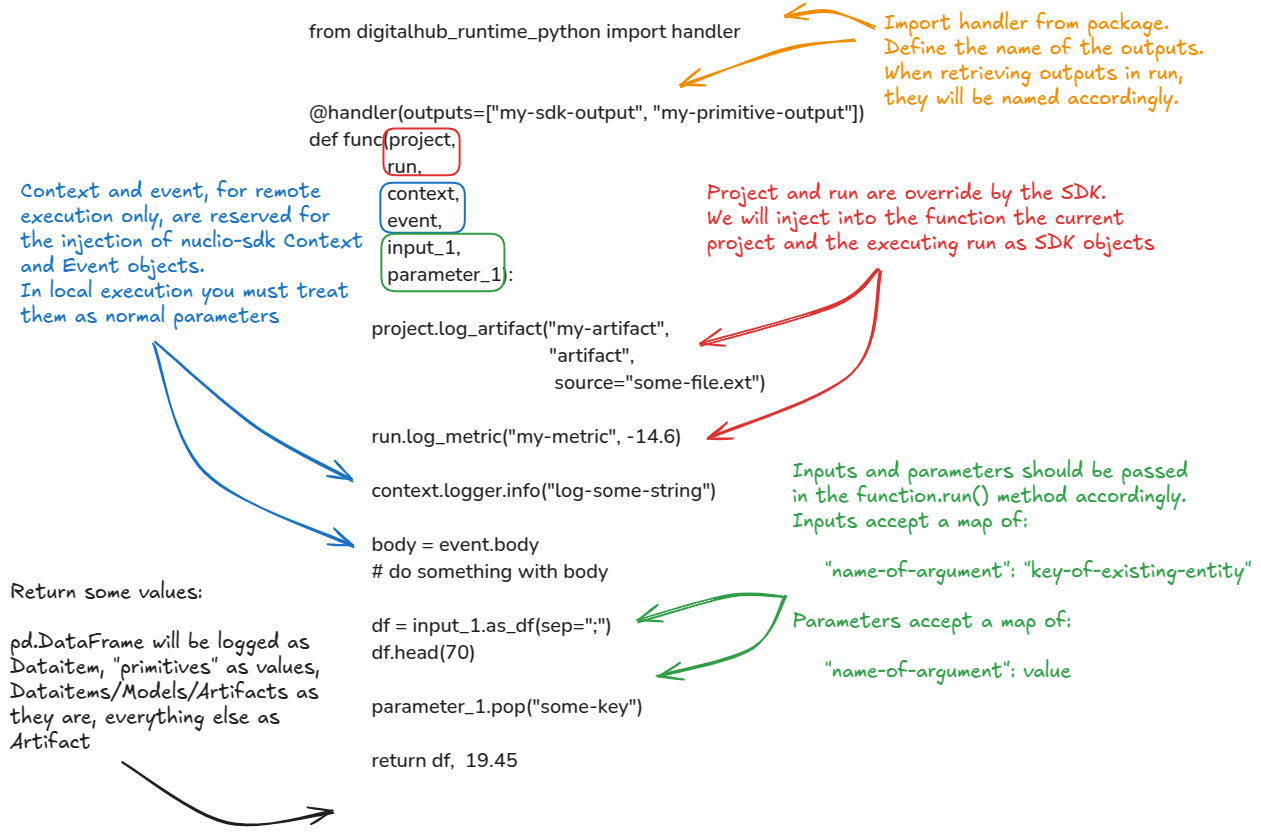
Example handler:
def func(project, run, context, event):
    run.log_metric("my-metric", -14.6)
    context.logger.info("log-some-string")

    body = event.body
    # Process the event body

    df = input_1.as_df(sep=";")
    df.head(70)

    parameter_1.pop("some-key")

    return df, 19.45
Simple handler (no parameters, no return):
The function you define becomes the entrypoint when referenced as the handler in the run configuration.
Reserved arguments
The runtime injects a small set of reserved arguments when it invokes your handler. Commonly injected values are:
project— the currentProjectobject.run— the activeRunobject.context— the Nuclio runtime context object (see Nuclio Python runtime docs) — only available in remote execution.event— the Nuclio event object — only available in remote execution.
For the handler function the following assumptions should be taken into account
- eventual processing errors are suppressed and ignored by the middleware; the request passes through.
- if it is necessary to change the status of the response (in pre- or post mode), it is necessary for handler to return an
nuclio_sdk.Responsestructure containing thestatus_codefield with the corresponding status code different from 0. - if in case of
wrapprocessorupon request event it is necesary to prevent the propagation to the upstream service, the wrap processor should return the result asnuclio_sdk.Responsewith the corresponding status code. - to distinguish the processing phase of ExtProc, the processing-phase header is appended to the event object. The possible values are:
- process request headers: 1
- process request body: 2
- process response headers: 4
- process response body: 5
Init function
If defined, Nuclio wrapper calls an init function (if present) before invoking your handler. The runtime injects the Nuclio context into init at invocation time. Additional parameters may be supplied via init_parameters in function.run().